

How Does a Car Subscription Work?

August 24, 2026
How Does a Car Subscription Work?
How does a car subscription work? You pay one start fee, then one monthly payment that covers the car, registration, routine maintenance, roadside assistance, and a mileage allowance, 1,000 miles per month included at Autonomy. It renews month to month until you cancel, with no multi-year contract.
If you are weighing a monthly car subscription against a lease, a loan, or a long rental, this is the practical version of how car subscriptions work, not the 2022 press-release version. It comes from Autonomy: we own and operate the subscription fleet, and we will be straight about where a lease beats us. Every Autonomy figure below is our current catalog pricing and terms as of August 2026, and the key market figures name their sources. That matters, because several of the best-known early subscription programs shut down years ago; the downsides section names them.
What is a car subscription?
A car subscription is a month-to-month service that puts you in a car for one start fee and one monthly payment, with registration, routine maintenance, and roadside assistance handled by the operator. It ends with notice instead of a contract buyout, the core difference from leasing.
Autonomy's version is the literal one: one start fee, one monthly payment, month to month until you cancel. We own and register the vehicles; you subscribe to one, and the renewal is automatic. Because a subscription is a service rather than financing, there is no loan and no debt on your credit file.
Programs differ across the market. Some are run by automakers, some by rental companies, some by dedicated operators, so the fine print covered below is worth checking with any provider you consider. For the market-level view of how the electric side of the industry is structured, see our analysis of electric vehicle subscription models.
How does a car subscription work, step by step?
At Autonomy, a subscription runs in five steps: choose a car, pick a start-fee and monthly-payment plan, pass an eligibility check and show proof of insurance, pay the drive-off amount, then drive on monthly autopay until you give us 14-day notice and hand back the keys.
- Choose your car. The lineup covers 13 models, 7 electric vehicles (EVs) and 6 gas, across sedans, SUVs, trucks, and a coupe, from a pre-owned Tesla Model 3 to a Ford F-150. Sign-up runs through the Autonomy app: pick the car, scan your license and payment card, and schedule pickup or delivery. You can preview the current Autonomy vehicle lineup before downloading anything.
- Pick a plan. Every priced car posts three plans, Explore, Experience, and Enjoy, with start fees of $1,000, $2,000, and $3,000. A higher start fee buys a lower monthly payment, the same tradeoff as a capitalized cost reduction on a lease, and the posted price does not vary by credit score.
- Clear the eligibility check and sort insurance. Every subscriber passes an eligibility check. For insurance, you either show proof of your own policy before the car is delivered or, if eligible, add integrated coverage underwritten by a third party for an additional fee.
- Pay the drive-off amount. At signing you pay the start fee, the first monthly payment, any add-ons, and a refundable security deposit. Posted prices exclude taxes, insurance, and that deposit, and both the start fee and the monthly can go on a credit card.
- Drive, then decide monthly. Payment runs on autopay each month from your start date, with 1,000 miles a month included. After the 31-day minimum hold, cancel with 14 days of notice and pay nothing to end, or switch cars by ending one subscription and starting another.
To watch the five steps play out with one specific car, from reservation through return, read the Tesla Model 3 subscription walkthrough.
How much does a car subscription cost per month?
Autonomy's posted prices run $300 to $700 a month as of September 2026, plus a one-time start fee of $1,000 to $3,000. Taxes, insurance, and a refundable security deposit sit outside those numbers. The more you put into the start fee, the less you pay each month.
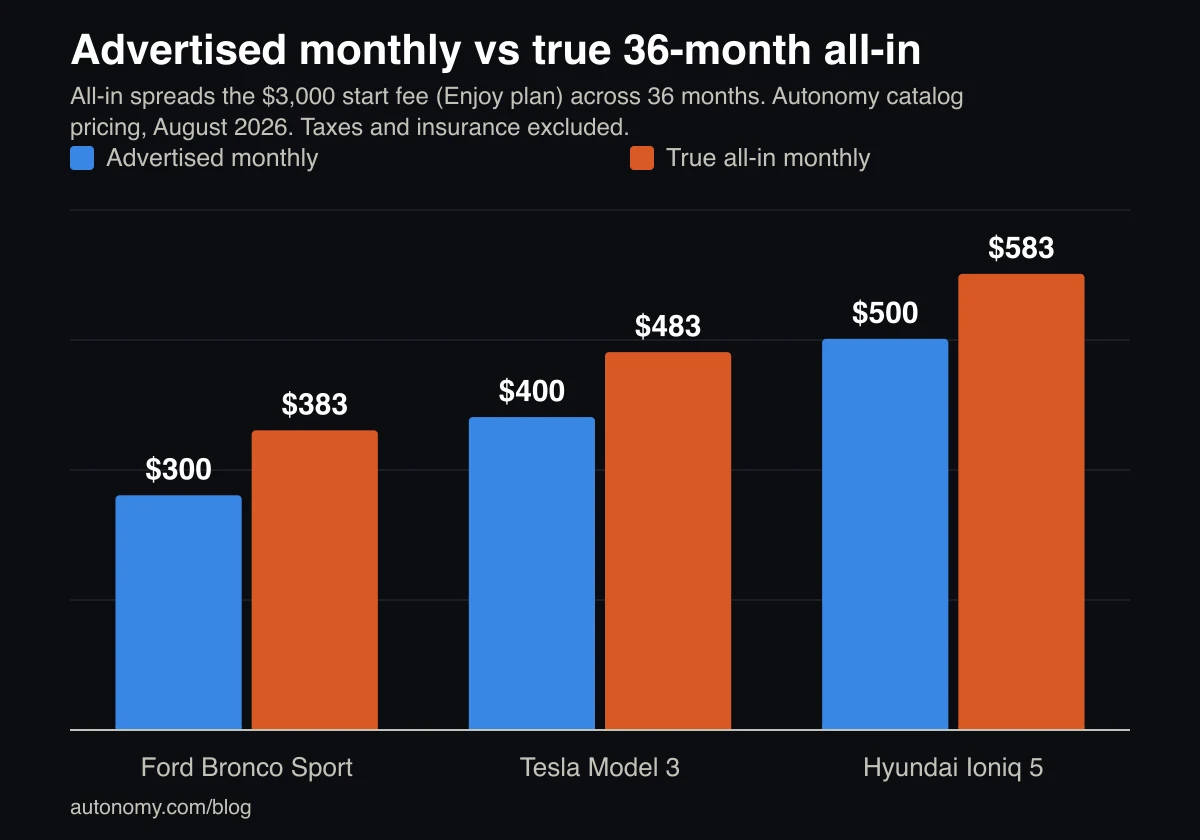
Do the start-fee math before you trust any advertised monthly, ours included. Spread the $3,000 Enjoy start fee across 36 months, as the chart above does, and on September 2026 catalog pricing the $300 Bronco Sport is really $383, the $500 Ioniq 5 is really $583, the $600 Model 3 is really $683. That all-in number is the one to hold up against a lease payment.
The three plans map to how long you expect to stay: Explore is built for a few months, Experience for about a year, Enjoy for more than a year. The full catalog price list, current as of September 2026:
| Vehicle | Explore ($1,000 start fee) | Experience ($2,000 start fee) | Enjoy ($3,000 start fee) |
|---|---|---|---|
| Volkswagen ID.4 (2023, used) | $575/mo | $525/mo | $475/mo |
| Tesla Model 3 | $700/mo | $650/mo | $600/mo |
| Ford Mustang Mach-E | $650/mo | $600/mo | $550/mo |
| BMW i4 | $700/mo | $650/mo | $600/mo |
| Chevrolet Blazer EV | $700/mo | $650/mo | $600/mo |
| Chevrolet Equinox EV | $550/mo | $500/mo | $450/mo |
| Hyundai Ioniq 5 | $600/mo | $550/mo | $500/mo |
| Ford Bronco Sport (2023, used) | $400/mo | $350/mo | $300/mo |
| Ford Escape (2023, used) | $400/mo | $350/mo | $300/mo |
| Ford Explorer | $700/mo | $650/mo | $600/mo |
| Ford Ranger | $600/mo | $550/mo | $500/mo |
| Ford Mustang | $650/mo | $600/mo | $550/mo |
| Ford F-150 | $650/mo | $600/mo | $550/mo |
Every price above excludes taxes, insurance, and the refundable security deposit. Availability varies by market and changes month to month, so the live site is the source of truth for what you can subscribe to today.
On the used Ford models, the posted rate is for the lowest-priced unit in current inventory; your rate is set per vehicle.
And hold a car long enough to spread the start fee thin, and the lowest true all-in in the lineup works out to about $383 a month on September 2026 pricing: a 2023 Ford Bronco Sport on the Enjoy plan, kept for 36 months. Tesla Model 3 subscription pricing starts at $600 a month plus a one-time start fee.
What's included in a car subscription, and what isn't?
Your monthly payment at Autonomy covers 1,000 miles a month, title, registration and licensing, routine maintenance, and roadside assistance, plus a free charging kit on electric models. It does not cover taxes, insurance, fuel or charging, parking, or tolls, and a refundable security deposit is collected separately.
- 1,000 miles a month, about 33 miles of included driving a day, with additional miles at $0.25 each.
- Title, registration, and licensing, an estimated $600 value, with the paperwork handled for you.
- Routine maintenance, an estimated $2,350 value: on gas cars that covers the oil changes, and on EVs scheduled service is booked and covered.
- Roadside assistance on every subscription (limitations apply).
- A free charging kit on electric models only, an estimated $230 value.
Our own tally puts the estimated value of those inclusions at $3,180 on an EV and $2,950 on a gas car. What you still pay for yourself: taxes, insurance, fuel or charging, parking, tolls, and the refundable security deposit due at signing.
Do car subscriptions include insurance?
Sometimes, and it is the first fine-print item to check with any provider. Autonomy's posted prices do not include insurance: you bring your own policy and show proof before delivery, or third-party coverage is available inside the subscription for eligible subscribers for an additional fee.
The fee for the integrated option varies by individual and is subject to the policy's terms, so there is no honest flat number to print here. Insurance is also where subscription and lease paperwork diverge most: a lessor dictates coverage requirements you shop for separately. The details trip people up often enough that the question gets its own answer on our subscription vs lease page.
Do car subscriptions have mileage limits?
Yes, almost every program meters mileage. Autonomy includes 1,000 miles per month, about 33 miles of driving a day, and charges $0.25 for each additional mile, billed monthly if your usage regularly runs past the allowance set in your subscription summary.
The difference from a lease is when you settle up. A lease carries an annual cap with per-mile penalties reconciled at turn-in, sometimes years after the driving happened; a subscription bills overage as it happens.
Do the math before you commit. A 1,500-mile month is 500 miles over, and 500 miles at $0.25 each is $125 on top of that month's payment. Fine occasionally, expensive as a habit.
How is a car subscription different from a lease or a rental?
A subscription is a rolling monthly service, a lease is a fixed multi-year contract, and a rental is transportation by the day. The practical differences show up in the money at signing, what the payment covers, and what it costs you to walk away early.
A rental answers a days-long need at a daily price, and the overlap ends there. The table below sticks to the decision you are actually running numbers on: subscription vs lease.
| Aspect | Car subscription (Autonomy) | 36-month lease |
|---|---|---|
| Commitment | Month to month after a 31-day minimum | Fixed term, 36.66 months on average (Experian, Q1 2026) |
| Money at signing | One start fee, $1,000–3,000 | Typically $3,999–5,000 due at signing on advertised deals (August 2026) |
| What the payment covers | Car, registration, routine maintenance, roadside assistance, 1,000 miles a month | The car; insurance, upkeep after the included window, and registration renewals are extra |
| Getting out early | 14 days of notice after the minimum, $0 to end | Remaining payments plus fees, often thousands of dollars |
| End of term | Nothing ends unless you end it | A forced decision at month 36, plus a $350–500 disposition fee |
| Mileage | 1,000 miles a month included, $0.25 per additional mile | Annual caps with per-mile penalties at turn-in |
| Switching cars | End one subscription, start another | Locked to one car for the term |
| Credit | No loan or lease obligation on your credit file; eligibility check required | A credit application and a multi-year obligation |
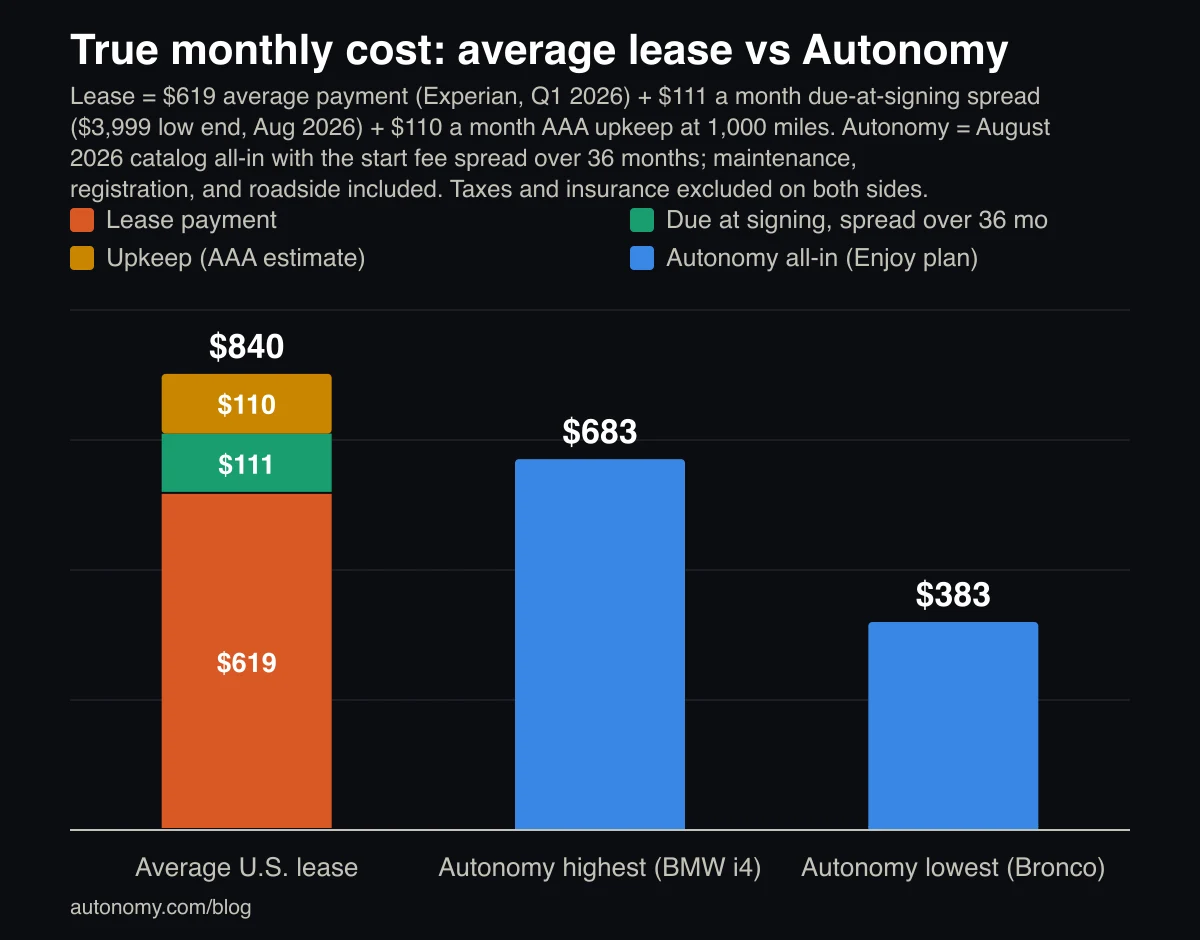
The lease figures above are national numbers with named sources, not strawmen. Experian's State of the Automotive Finance Market puts the average new-vehicle lease payment at $6191 on a 36.66-month average term in Q1 2026.
The signing and exit costs are sourced too. Advertised August 2026 lease deals mostly required $3,999 to $5,000 due at signing2, per FindTheBestCarPrice's monthly deal roundup; the disposition fee at turn-in typically runs $350 to $5003, per SoFi's lease disposition guide; and U.S. Bank's published early-return example totals $10,820.684.
Now add upkeep. AAA's September 2025 Your Driving Costs estimate for maintenance, repair, and tires is 11.04 cents per mile5, roughly $110 a month at 1,000 miles. Stack that on top and the advertised lease payment stops being the real monthly cost.
Buying is a different question entirely: a path to ownership in exchange for a down payment, a multi-year loan, and every running cost on you. It deserves its own math. For the line-by-line version of the two-way matchup, see the full car subscription vs lease breakdown.
Is a car subscription worth it?
It depends on how predictable your next three years are. Keep one car for a full 36-month lease term at steady mileage and the lease's monthly payment usually wins; if your job, your city, or your family situation is in motion, the subscription usually wins.
The honest version: keep a 36-month lease for all 36 months at predictable mileage and its monthly payment usually beats a subscription. That concession is ours, not a competitor's. What the subscription buys is everything that happens when life does not follow the contract. The month a lease would force a decision, nothing happens.
Two numbers frame the comparison. Our vs-lease math finds the average lease really costs about a third more per month than its advertisement once signing money, the disposition fee, and upkeep are spread across the term. And a subscription gets cheaper the longer you spread its start fee: on August 2026 catalog pricing, the lowest 36-month all-in in the lineup is about $383 a month.
Where a subscription is clearly worth it, as of 2026: you need a car for a stretch measured in months, a use case banks almost never write leases for; you want no multi-year obligation and no debt on your credit file; or you want to live with an EV before committing to one, since switching from electric to gas is just ending one subscription and starting another.
Where it is not: you drive well past 1,000 miles a month, your next three years are predictable, and the lowest possible monthly cost is your only metric.
What are the downsides of a car subscription?
Cost, coverage area, and mileage are the honest tradeoffs. A subscription's flexibility carries a premium over a lease you keep full-term, most operators serve limited regions, allowances like 1,000 miles a month can pinch heavy commuters, and the young industry has already seen many programs fold.
Get specific about each one. Autonomy operates in California, Florida, New York, Texas, and Washington, with pickup or delivery throughout those states and Arizona and Nevada named as next. Much of the country cannot subscribe yet.
Every subscription carries a 31-day minimum hold, and the initial term is non-cancellable and non-refundable apart from the security deposit. Excess mileage and excess wear-and-tear fees can be charged if usage regularly runs past the allowance.
And these are fleet vehicles. We own and register them, some are pre-owned, the Tesla Model 3 fleet is 2021–2023 Standard Range rear-wheel-drive (RWD), and all are covered under warranty. If you are expecting a factory-fresh custom build, you are shopping the wrong product.
One more downside belongs to the industry rather than the product. Car subscriptions boomed and busted once already: by 2023, early programs including Fair, Canvas, BMW's Access, and Book by Cadillac had all shut down. Before you hand any operator a start fee, confirm the program is actually accepting subscribers this month.
Frequently asked questions
Can you cancel a car subscription at any time?
At Autonomy, yes, after the 31-day minimum hold: give 14 days of notice, hand back the keys, and pay nothing to end, with no early-termination or disposition fee.
Can you buy the car at the end of a subscription?
Not yet. Autonomy is transitioning to a path-to-ownership model, and the mechanics are not fully live, so buyout terms are not published today. The subscription still ends with 14 days of notice and a return. Ownership options will surface on the homepage and in plan terms as they roll out.
What credit score do you need for a car subscription?
Autonomy does not publish a score threshold; an eligibility check is required, but posted prices do not vary by credit score, and no loan or lease obligation lands on your credit file.
Where are car subscriptions available?
Autonomy currently operates in California, Florida, New York, Texas, and Washington, with pickup or delivery throughout those states; other providers set their own coverage areas.
What happens if you change your mind before pickup?
Cancel the reservation by calling 800-288-6666 before activation and the entire security deposit is refunded, no questions asked, within 5 to 7 business days.
See the cars, then run your own month
Prices above are current as of September 2026 and can change; the terms, the 31-day minimum hold, the 14-day notice, and the $0 exit, are the point of the product. When you are ready to run a real month of your life against a real car, browse the full Autonomy fleet with every posted plan price.
Sources and fine print
- Experian, State of the Automotive Finance Market, Q1 2026: average new-vehicle lease payment of $619 on an average new-lease term of 36.66 months.
- FindTheBestCarPrice, lease deal roundup, August 2026: advertised lease deals mostly requiring $3,999 to $5,000 due at signing.
- SoFi, lease disposition fee guide: disposition fees at turn-in typically $350 to $500.
- U.S. Bank, returning a leased vehicle early: published worked example totaling $10,820.68.
- AAA, Your Driving Costs, September 2025: maintenance, repair, and tires averaging 11.04 cents per mile.
Every Autonomy price, plan, and term in this post comes from our posted catalog and plan disclosures, current as of September 2026, and each pricing paragraph is annotated with its catalog source. Posted prices exclude taxes, insurance, and a refundable security deposit, and can change. Last updated: August 21, 2026.